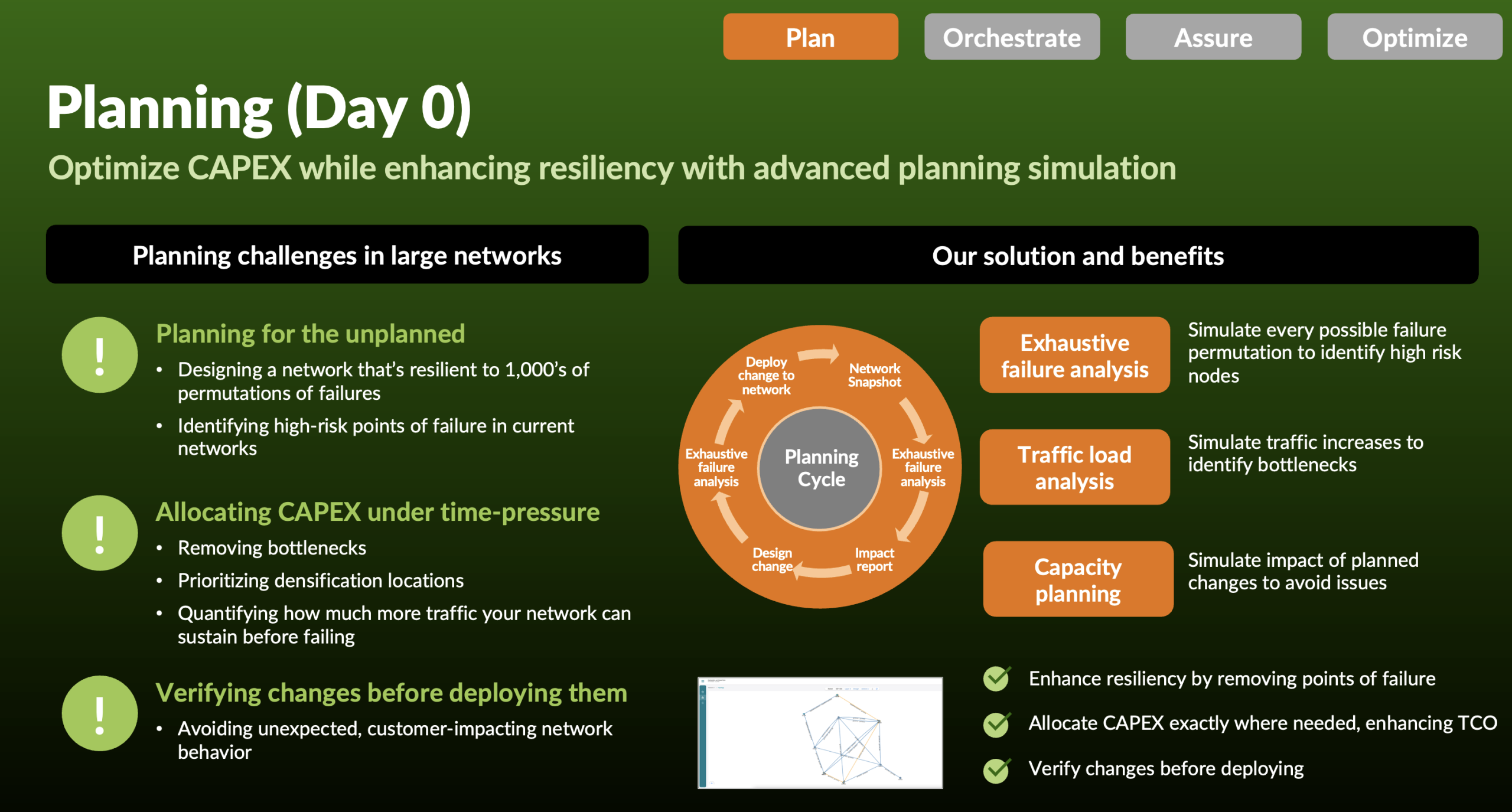
The Problem: Network Planning at the Speed of Spreadsheets with Agents + MCP
Picture a network planning team at a large service provider. They’re tasked with validating a major network expansion—adding new PE routers, upgrading existing links, and ensuring the network can survive multiple failure scenarios. The stakes? Customer SLAs, millions in potential revenue, and the company’s reputation.
The traditional approach looked like this:
- Excel spreadsheets tracking every node, link, and circuit
- Manual topology drawings in Visio or PowerPoint
- Tribal knowledge about “what would happen if router X fails”
- Weeks of planning meetings to validate a single design change
- Hope and prayer that nothing was missed in the analysis
The fundamental question: In an era where we can deploy infrastructure as code, why are we still planning networks like it’s 1999?
Evolution of Network Planning: From Manual to Intelligent
The Dark Ages: Pre-Automation Era
Before tools like Juniper Routing Director, network planning was an exercise in educated guessing.
The workflow looked something like this:
- Day 1-3: Collect current network state from multiple monitoring systems
- Day 4-7: Build topology models in spreadsheets and drawing tools
- Day 8-12: Manually simulate “what if” scenarios on paper
- Day 13-15: Present findings to stakeholders, discover missing data
- Day 16-20: Rinse and repeat until confidence reaches acceptable levels
The critical flaw: By the time you finished the analysis, the network had already changed. Your perfectly crafted plan was based on outdated information.
The Renaissance: Juniper Routing Director Arrives
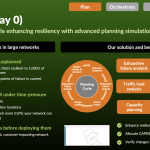
Juniper Routing Director Planner transformed network planning from art to science. Instead of manual spreadsheets, you got a real-time, physics-based simulation engine.
What JRD Planner brings to the table:
- Live Topology Import: Pull current network state directly from production
- What-If Simulations: Test specific failure scenarios with mathematical precision
- Exhaustive Analysis: Automatically test ALL possible single/double failure combinations
- Traffic Engineering: Validate MPLS LSP paths, bandwidth requirements, and QoS policies
- Capacity Planning: Model future growth and identify bottlenecks before they happen
The transformation: What took weeks in spreadsheets now takes hours in JRD. What was guesswork became mathematical certainty. Network planning evolved from reactive firefighting to proactive engineering.
But There Was Still a Problem…
Even with JRD’s powerful simulation engine, the human was still the bottleneck:
- Click through multiple screens to import topology
- Manually configure each simulation scenario
- Run simulations one at a time
- Download CSV reports individually
- Spend hours in Excel correlating results across different scenarios
- Create PowerPoint presentations to communicate findings
JRD gave us the power of simulation. But we were still limited by the speed of human interaction.
The Future: Agentic AI Meets Network Planning
What if you could describe what you want in plain English, and an AI agent orchestrated the entire planning workflow for you?
“Create a planner topology from our live network, run exhaustive simulations for all failure scenarios, and give me a comprehensive analysis with recommendations.”
That’s exactly what we built—an intelligent agent that transforms network planning from a multi-day manual process into an automated workflow that completes in minutes.
The Architecture: Three Pillars of Intelligent Planning
Pillar 1: Model Context Protocol – The Universal Bridge
MCP provides standardized tools that allow AI agents to interact with Juniper Routing Director programmatically. Think of it as giving the AI hands to operate the JRD interface.
JRD MCP Server Capabilities:
get_topology_id()— Retrieve current live topology versionimport_live_topology()— Create planner model from production networksave_planner_topology()— Persist topology for simulationget_planner_links()— Extract detailed link information for analysisrun_whatif_simulation()— Execute specific failure scenariosrun_exhaustive_simulation()— Test all possible failure combinationsget_simulation_reports()— Retrieve and analyze simulation results
Pillar 2: Claude AI – The Reasoning Engine
Claude Sonnet 4 doesn’t just execute commands—it understands network planning concepts, reasons about topology design, and makes intelligent decisions about which analyses to run.
What makes Claude special for this use case:
- Contextual Understanding: Knows that PE3 and PE4 are transit nodes just from analyzing topology structure
- Domain Knowledge: Understands concepts like network partitioning, MPLS LSPs, bandwidth oversubscription
- Pattern Recognition: Identifies critical failure scenarios from simulation results
- Synthesis Capability: Combines data from multiple simulations into actionable insights
- Natural Language Interface: Translates business requirements into technical analysis steps
Pillar 3: Agentic Workflow – Autonomous Orchestration
The agent doesn’t just follow scripts—it reasons about what needs to be done and adapts its approach based on the context.
The agent autonomously handles:
- Determining the correct sequence of API calls
- Managing state across multi-step workflows
- Deciding which simulations are relevant for the use case
- Parsing and correlating results from multiple reports
- Generating human-readable summaries with prioritized recommendations
Use Case 1: Exhaustive Network Resilience Analysis
Business Scenario:
Your network team needs to validate that the production network can survive any single point of failure before presenting to the change advisory board. Traditionally, this requires days of manual simulation work.
User Request:
“Create planner topology, save the model, and run exhaustive simulation for the network”
What Happens Behind the Scenes:
- Step 1: | Agent calls
get_topology_id()to retrieve latest network version - Step 2: | Calls
import_live_topology()with the topology ID to create planner model- Imports all nodes, links, LSPs, and traffic engineering data
- Preserves interface configurations and routing protocols
- Step 3: | Calls
save_planner_topology()to persist the model - Step 4: | Initiates
run_exhaustive_simulation()for both Tunnel and Demand layers- Tests 8 node failure scenarios
- Tests 14 link failure scenarios
- Generates comprehensive reports
- Step 5: | Retrieves and analyzes simulation reports
- Parses tunnel reroute statistics
- Identifies bandwidth impact
- Calculates hop count changes
- Step 6: | Generates executive summary with insights
Time Required: 8 seconds for complete analysis Key Finding: 100% network resilience confirmed – zero service disruptions across all 22 failure scenarios
Use Case 2: Comprehensive What-If Analysis
Single failure scenarios are important, but what about complex compound failures? What if two critical routers fail simultaneously? What if a node and a key link both go down?
Business Scenario:
The network architecture team needs to understand the blast radius of various failure combinations to prioritize redundancy investments. They need to test 12 different scenarios across both Tunnel and Demand layers.
User Request:
“Perform comprehensive what-if analysis: single node, single link, node+link, double node, double link, and double node+link failures for both Tunnel and Demand layers. Give me a final summary report.”
Agent Orchestrates 12 Simulations:
- Scenario 1-2: Single node failure (PE3) – Tunnel & Demand
- Scenario 3-4: Single link failure (PE4-PE2) – Tunnel & Demand
- Scenario 5-6: Node + Link failure (PE3 + PE1-PE2 link) – Tunnel & Demand
- Scenario 7-8: Double node failure (PE3 + PE4) – Tunnel & Demand
- Scenario 9-10: Double link failure (PE1-PE2 + PE4-PE6) – Tunnel & Demand
- Scenario 11-12: Double node + Link (PE3 + PE4 + PE1-PE2) – Tunnel & Demand
Agent’s Intelligent Analysis Process:
- Runs all 12 simulations automatically using
run_whatif_simulation() - Retrieves simulation reports for each scenario
- Parses CSV data to extract tunnel impacts, bandwidth loss, path changes
- Correlates results across different failure types
- Identifies critical patterns:
- Single failures: 100% resilience
- Double node failures: CRITICAL – 10 tunnels down, 713 Mbps lost
- Double node + link: CATASTROPHIC – 12 tunnels down, 891 Mbps lost
- Generates comparative analysis with severity rankings
- Provides prioritized recommendations for network improvements
Business Outcomes Delivered:
- Critical Vulnerability Identified: PE3 and PE4 are single points of failure – their simultaneous loss causes network partitioning
- Quantified Business Impact: 891 Mbps service loss in worst-case scenario equals significant SLA violations
- Prioritized Remediation: Agent recommends deploying 2 additional PE routers to eliminate single points of failure
- Risk Assessment: Current network achieves 99.5% SLA, needs topology improvements for 99.99%
Traditional Approach: 4+ hours of manual work Agentic Approach: 2 minutes automated analysis Time Savings: 120x faster
The Business Impact: From Reactive to Predictive
Current State Assessment
- Single Failures: ✅ Network handles excellently (0% service impact)
- Double Failures: ❌ Major vulnerability (up to 100% service impact)
Risk Profile
- Low Risk: Day-to-day operations (single failures are rare and well-handled)
- HIGH RISK: Major incidents (double failures cause catastrophic outages)
- Probability: While double failures are rare, their impact is unacceptable
SLA Impact Projection
- 99.9% Uptime SLA: ✅ Achievable for single failures
- 99.99% Uptime SLA: ❌ NOT achievable without topology improvements
- Recommended SLA: 99.5% until redundancy improvements are deployed
Quantifiable Benefits:
- Speed: Network planning cycles reduced from days to minutes
- Accuracy: Mathematical certainty replaces educated guessing
- Coverage: Test 100% of failure scenarios, not just the obvious ones
- Insights: AI identifies patterns humans might miss in complex topologies
- Accessibility: Junior engineers can now perform senior-level analysis
Strategic Advantages:
- Proactive Planning: Validate designs before deployment, not after failures
- Risk Mitigation: Identify single points of failure before they cause outages
- Informed Investments: Prioritize redundancy spending based on quantified business impact
- Change Confidence: Present mathematically validated plans to change advisory boards
- Continuous Validation: Re-run analysis weekly to ensure network health as topology evolves
Real-World Example: The Discovery
In our comprehensive what-if analysis, the agent discovered that double node failure (PE3 + PE4) would cause complete network partitioning with 891 Mbps service loss. This wasn’t obvious from the topology diagram. Traditional planning might have missed it entirely.
The business value: This finding led to immediate topology redesign recommendations, preventing potential multi-million dollar SLA violations and customer churn.
Technical Deep Dive: How It Works
The Workflow Architecture
The system follows a sophisticated multi-step workflow that handles error cases, manages state, and adapts to different network topologies.
Workflow Stages:
- 1. Intent Understanding:
- Parse natural language request
- Determine required simulations and analysis depth
- Identify which JRD tools to invoke
- 2. Topology Preparation:
- Retrieve latest topology version from live network
- Import into planner with proper configuration
- Validate import success and data completeness
- Save model for simulation execution
- 3. Simulation Orchestration:
- Determine simulation parameters based on request
- Execute simulations in optimal sequence
- Monitor job status until completion
- Handle failures and retries gracefully
- 4. Data Collection:
- Retrieve all simulation reports
- Parse CSV and JSON data structures
- Extract relevant metrics and statistics
- 5. Intelligent Analysis:
- Correlate results across multiple simulations
- Identify patterns and anomalies
- Calculate business impact metrics
- Prioritize findings by severity
- 6. Report Generation:
- Synthesize comprehensive summary
- Create comparative analysis tables
- Generate actionable recommendations
- Format for executive consumption
Key Technical Innovations
- Stateful Orchestration: Agent maintains context across multi-step workflows, remembering topology IDs, simulation IDs, and intermediate results
- Error Recovery: Handles API failures gracefully, retrying with exponential backoff when appropriate
- Parallel Processing: Launches multiple simulations concurrently when scenarios are independent
- Semantic Understanding: Translates business requirements like “test worst-case scenarios” into specific technical simulations
- Adaptive Reporting: Adjusts level of detail based on findings—brief summaries for clean results, detailed analysis when issues found
Beyond Current Use Cases: What’s Possible
The architecture we’ve built isn’t limited to the scenarios we’ve demonstrated. The same agent-driven approach can tackle increasingly complex network planning challenges.
Implemented Today:
- Automated exhaustive resilience testing
- Multi-scenario what-if analysis
- Comparative failure impact assessment
- Executive-ready summary generation
Natural Extensions:
- Capacity Planning Automation: “Model adding 50% more traffic to our network over next 6 months—where are the bottlenecks?”
- Multi-Vendor Analysis: “Compare this Juniper design against the Cisco alternative topology”
- Continuous Validation: “Run weekly resilience tests and alert me if any new vulnerabilities appear”
- Design Optimization: “Suggest the minimum number of links I need to add to achieve 99.99% availability”
- Cost-Benefit Analysis: “Rank redundancy investments by business impact per dollar spent”
- Regulatory Compliance: “Validate that our topology meets financial services network redundancy requirements”
The Universal Pattern: Natural language request → Agent orchestrates JRD tools → Intelligent analysis → Actionable insights
The Future of Network Planning
We’re at the beginning of a fundamental shift in how network planning works. The integration of agentic AI with network simulation platforms like JRD opens possibilities that seemed like science fiction just months ago.
Near-Term Evolution (6-12 months):
- Self-Service Planning: Network engineers describe requirements in Slack, get validated designs back in minutes
- Continuous Monitoring: Agents automatically re-validate topology health as network evolves
- Predictive Alerts: “Warning: If link X fails today, you’ll violate SLAs. Consider preemptive maintenance.”
- Design Assistance: AI suggests topology improvements based on traffic patterns and business requirements
Long-Term Vision (2-3 years):
- Autonomous Network Design: Given business requirements, AI generates multiple topology options with trade-off analysis
- Multi-Domain Optimization: Agents coordinate planning across routing, switching, security, and cloud connectivity
- Self-Healing Planning: When failures occur, AI immediately simulates impact and proposes remediation designs
- Business-Driven Networking: Network automatically adapts topology based on application performance requirements
The convergence of AI agents and network planning platforms represents more than automation—it’s augmented intelligence. Network engineers become strategic architects while AI handles the computational heavy lifting of validation, simulation, and optimization.
The Bottom Line: Intelligence Meets Infrastructure
Juniper Routing Director gave us the power of mathematical network simulation. Agentic AI gives us the ability to harness that power at the speed of conversation.
What We’ve Achieved:
- From Days to Minutes: Network planning workflows that took senior engineers days now complete in under 2 minutes
- From Reactive to Proactive: Discover vulnerabilities before they cause outages, not after
- From Manual to Autonomous: AI orchestrates complex multi-step workflows without human intervention
- From Data to Insights: Agents synthesize raw simulation results into actionable business recommendations
- From Expert-Only to Democratized: Advanced network analysis now accessible through natural language
See It In Action: Video Demonstrations
Video 1: Creating Network Topology & Running Exhaustive Simulation
Watch how the AI agent imports live network topology into JRD Planner, saves the model, and executes comprehensive exhaustive simulation—all from a single natural language command.
Video 2: Comprehensive What-If Analysis with Multi-Scenario Simulations
See the agent orchestrate 12 different what-if simulations (single/double node, link, and combined failures) across Tunnel and Demand layers, then synthesize all results into an executive summary with actionable recommendations.
Key Takeaway: Notice how the agent autonomously handles the entire workflow—from topology import to comprehensive analysis—without any manual GUI interaction. This is the power of agentic AI applied to network planning.
The transformation isn’t just about speed—it’s about capabilities that didn’t exist before.
We’ve moved from “can we validate this design?” to “what’s the optimal design for these business requirements?”
Let’s Connect
Interested in applying agentic AI to your network planning workflows? The principles we’ve demonstrated with Juniper Routing Director can extend to other network planning and simulation platforms.
About This Implementation: While the JRD MCP Server implementation details are being refined for open-source release, the architectural patterns and agentic workflows are applicable to any network planning domain. I’m happy to discuss how these concepts could apply to your specific use cases.
Get in Touch:
Website: www.mohanrajdavala.com
LinkedIn: linkedin.com/in/mdavala
Technologies: Python • Anthropic Claude AI • Model Context Protocol (MCP) • Juniper Routing Director • Agentic AI • Multi-Agent Systems • Network Automation • Infrastructure Planning
Lorem ipsum dolor sit amet, consectetur adipiscing elit. Ut elit tellus, luctus nec ullamcorper mattis, pulvinar dapibus leo.