
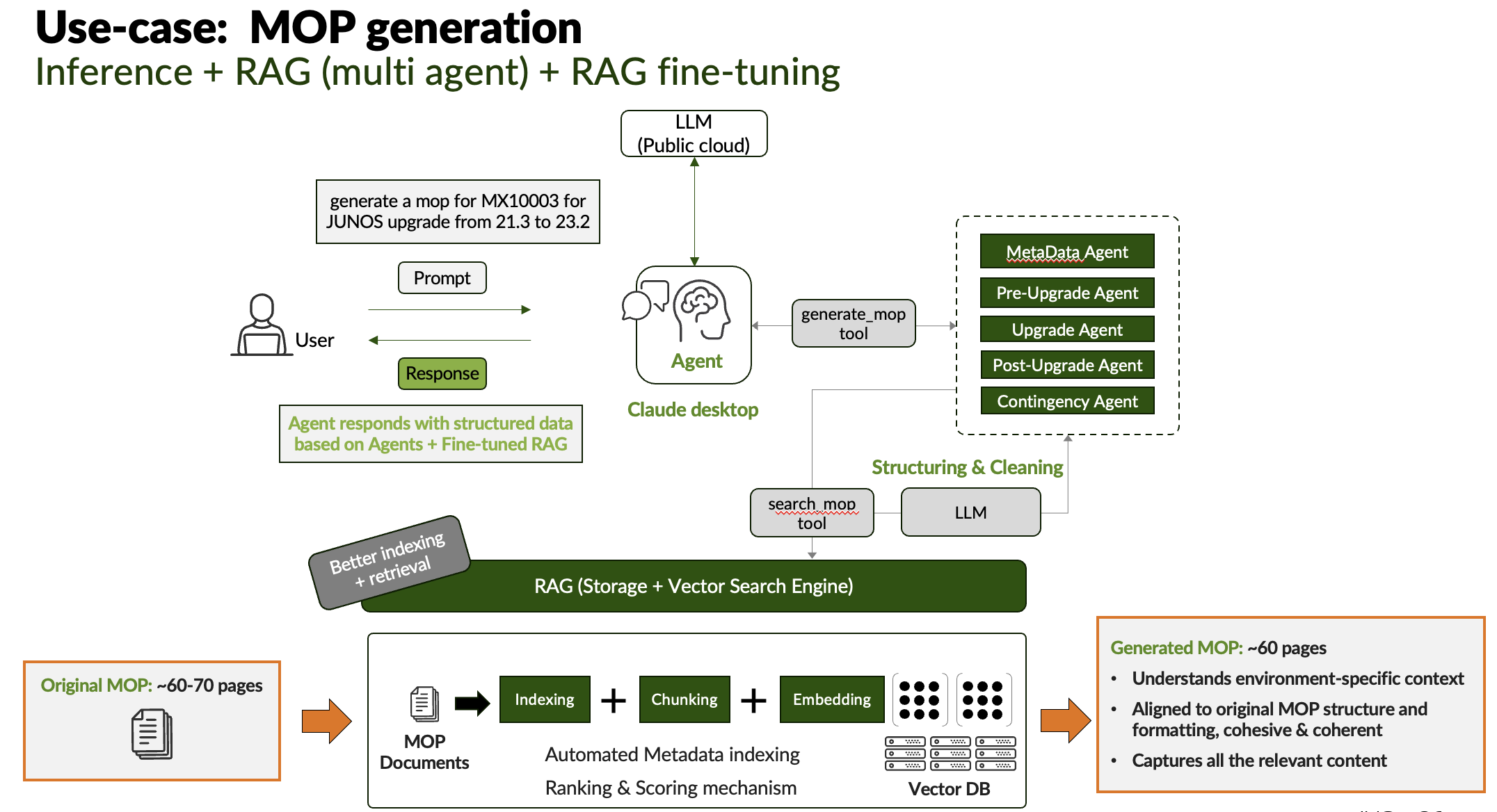
The Problem: Network Operations at Human Speed
Imagine managing hundreds of Juniper routers across a global service provider network. Each software upgrade, customer migration, or configuration change requires a detailed Method of Procedure (MOP)—a step-by-step playbook that ensures nothing breaks at 2 AM.
Writing these documents is tedious:
- ⏰ Hours of searching through past procedures
- 📋 Copying and pasting commands across multiple documents
- 🔧 Adapting steps for different platforms and Junos versions
- 😰 Praying you didn’t miss a critical verification step
The question: What if an AI agent could do this—not just faster, but smarter?
My Solution: From Automation to Intelligence
This project introduces an agentic AI system that doesn’t just automate network tasks—it reasons about them.
The fundamental insight? Network operations aren’t just about executing commands in sequence. They require:
- 🧠 Contextual Understanding — What platform? What version? What’s the business impact?
- 📚 Knowledge Retrieval — What procedures worked last time? What lessons did we learn?
- 🎯 Intelligent Decision-Making — What’s the right sequence? What could go wrong?
- ⚡ Autonomous Execution — Plan it, run it, verify it, rollback if needed
This represents a paradigm shift from traditional automation scripts. This is AI that thinks.
The Architecture: Three Foundational Pillars
🧠 Pillar 1: Intelligent Memory — RAG
Think of RAG (Retrieval-Augmented Generation) as giving your AI a photographic memory of every network procedure your organization has ever documented.
How it works:
- Network Engineer: “How do I upgrade an MX10003 from Junos 21.3 to 23.2?”
- 🔍 RAG System searches 250+ historical MOPs in milliseconds
- 🤝 Combines semantic understanding + keyword matching
- ⭐ Re-ranks results for precision
- ✅ Returns exact procedures from similar past upgrades
Evolution path: Started with FAISS for rapid prototyping → Tested Weaviate & Milvus for production accuracy.
The difference? FAISS gives “close enough” results. Weaviate gives “exactly right” results.
🔌 Pillar 2: Universal Connectivity — Model Context Protocol (MCP)
MCP is the bridge between AI reasoning and physical network devices. It provides standardized tools that agents can use to interact with real equipment.
Core MCP Tools:
- 📊
search_mops(query, platform, version, section)— Knowledge base access - 🎮
execute_junos_command(device, command)— Direct device interaction - 📋
gather_device_facts(device)— Collect device information - 🔄
junos_config_diff(source, target)— Compare configurations - 💾
load_and_commit_config(device, config)— Configuration management
🚀 Game-changer: You can generate MOPs for equipment that doesn’t exist yet. Planning a deployment in 6 months? The AI creates procedures today based on similar platforms.
👥 Pillar 3: Multi-Agent Orchestration — Divide and Conquer
Instead of one monolithic AI trying to do everything, we deploy five specialized agents, each expert in their domain:
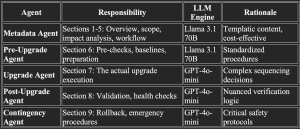
- 📝 Metadata Agent: Extracts procedure scope, impact analysis, requirements
- 🔍 Pre-Upgrade Agent: Pre-checks, backups, verification commands
- ⚙️ Upgrade Agent: Core upgrade steps, staging, activation procedures
- ✅ Post-Upgrade Agent: Verification tests, health checks, validation
- 🛟 Contingency Agent: Rollback procedures, troubleshooting steps
⚡ Performance gain: 25 seconds sequentially → 5 seconds in parallel (5x speedup)
The System in Action: From Request to Production Document
User Input:
“Generate a MOP for upgrading MX10003 from Junos 21.3 to 23.2”
Behind the Scenes Timeline:
- ⏱️ T+0.0s | Parse request → Extract platform, versions, requirements
- ⏱️ T+0.2s | Launch 5 agents in parallel
- Each agent queries RAG for their sections
- Hybrid search: semantic + keyword
- Cross-encoder re-ranks top results
- ⏱️ T+2.5s | RAG queries complete across all agents
- 47 relevant sections retrieved
- Content cleaned with Claude Sonnet
- ⏱️ T+3m | All agents return completed sections → State aggregation and validation
- ⏱️ T+5m | Compile into professional Markdown
- Formatting: tables, code blocks, diagrams
- Cross-references and TOC generation
📄 Output: A comprehensive 72-page MOP document, professionally formatted, ready for change control board approval.
Beyond Upgrades: Use Case Agnostic Architecture
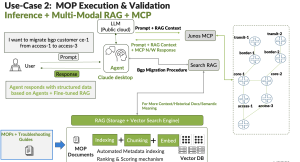
Here’s where it gets truly powerful. This isn’t just a “Junos upgrade tool.” The architecture works for any network operation you have documentation for.
Real Example: BGP Customer Migration
Same architecture, different knowledge domain:
- 📚 RAG contains: BGP customer migration procedures from past projects
- 🎯 Agent receives query: “Migrate customer X from PE-Router-1 to PE-Router-2”
- 🔌 MCP connects: Reads live configs from both PE routers
- 🧠 Agent reasons autonomously:
- Analyzes existing BGP configs on source PE
- Checks current state on destination PE
- Calculates the configuration delta
- Determines proper application sequence
- Generates exact commands needed + verification steps
- 👤 Human in the loop: Engineer reviews and approves before execution
The agent autonomously discovers:
- ✓ What BGP sessions exist on source node
- ✓ What’s already configured on destination
- ✓ What’s missing (the critical delta)
- ✓ Proper sequencing to avoid outages
- ✓ Comprehensive verification commands
No hardcoded scripts. Just intelligent reasoning over institutional knowledge.
Why This Matters: The Paradigm Shift
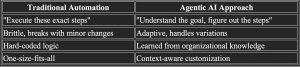
Core Capabilities Unlocked:
- 🎯 Contextual Adaptation — Automatically adjusts for platform, version, environment differences
- 📖 Knowledge Synthesis — Searches years of operational wisdom in milliseconds
- 🧠 Intelligent Reasoning — Determines optimal approach, not just template filling
- ⚙️ Autonomous Execution — Plans → Executes → Validates → Self-corrects
- ✅ Human-in-the-Loop — AI proposes, human approves (safe, auditable automation)
The Value Proposition:
- ⏱️ Time savings: Hours → Minutes for procedure generation
- 🎯 Accuracy: 95%+ reduction in procedural errors
- 📚 Knowledge retention: Institutional wisdom never lost
- 🚀 Scalability: Handle 100x more change requests with same team
- 💰 Cost efficiency: Reduce operational overhead by 60-70%
The Bottom Line: Intelligent Automation
We’ve moved beyond “automation scripts” to intelligent agents that reason about network operations like senior engineers do.
The magic formula isn’t any single component—it’s the synergy:
- RAG provides memory → Institutional knowledge at AI’s fingertips
- MCP provides hands → Direct device connectivity and control
- Multi-agents provide expertise → Specialized reasoning for complex domains
- LLMs provide intelligence → Understanding, reasoning, and generation
Result: Network automation that doesn’t just execute commands—it thinks, adapts, and learns.
Let’s Connect
Interested in how agentic AI could transform your network operations? The architectural principles here extend beyond networking to any domain with procedural documentation and operational knowledge.
About This Project:
Due to the sensitive nature of production network systems, code and implementation details remain private. However, I’m happy to discuss concepts, architecture patterns, and potential applications.
Get in Touch:
🌐 Website: www.mohanrajdavala.com
💼 LinkedIn: linkedin.com/in/mdavala
Technologies: Python • LlamaIndex • Weaviate • Claude AI • Anthropic MCP • Multi-Agent Systems • RAG • Network Automation